
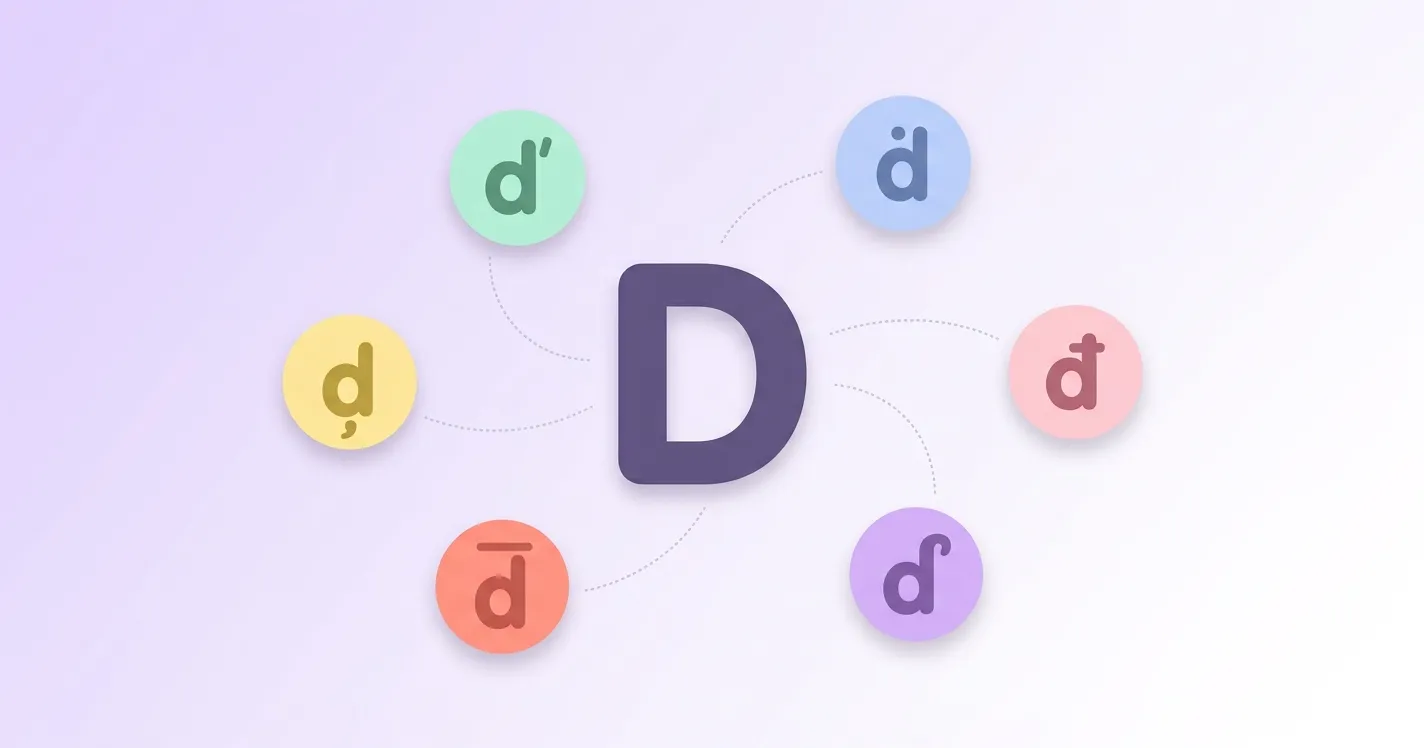

Below you will find every accented d symbol ready to copy with one click, a full alt code table for Windows, keyboard combos for Mac, and the Unicode, HTML, CSS, and JavaScript values developers need. Whether you are writing in Vietnamese, Czech, or Icelandic, or coding a page that needs the eth symbol, everything lives in this one guide.
D with accent Copy Paste
Every accented d symbol on this page is ready to copy with a single click. Tap the character you need and it is instantly saved to your clipboard, so you can paste it straight into a document, chat, spreadsheet, or line of code without typing a single alt code.
Lowercase d with accent
Capital D with accent
Alt Code for d with accent
Alt codes let Windows users type accented letters without switching keyboards. This works for d with caron (ď), d with cedilla (ḑ), d with stroke (đ), d with dot (ḋ, ḍ), and d with hook (ɗ) and others. Each symbol below has its own numeric alt code you can memorize or copy.
If you're interested in learning about other accented letters as well, along with their alt codes, you can check out this guide to all accented letters.
Follow these steps to type any of the characters using their alt code.
- Use a Windows desktop, or a laptop with a dedicated number pad, since alt codes only work through the numeric keypad.
- Turn on Num Lock so the number pad is active and ready for input.
- Place your cursor where you want the accented d to appear.
- Press and hold the Alt key on your keyboard.
- While still holding Alt, type the numeric code from the table below using the number pad only.
- Release the Alt key and the accented character will appear instantly.
| Symbol/Mark | Alt Code |
|---|---|
| ḋ | ALT 7691 |
| ď | ALT 271 |
| ḑ | ALT 7697 |
| đ | ALT 273 |
| ƌ | ALT 396 |
| ɗ | ALT 599 |
| ḍ | ALT 7693 |
| ḓ | ALT 7699 |
| ḏ | ALT 7695 |
| ð | ALT 0240 |
| dz | ALT 499 |
| dž | ALT 454 |
| Ḋ | ALT 7690 |
| Ď | ALT 270 |
| Ḑ | ALT 7696 |
| Đ | ALT 272 |
| Ƌ | ALT 395 |
| Ɗ | ALT 394 |
| Ḍ | ALT 7692 |
| Ḓ | ALT 7698 |
| Ḏ | ALT 7694 |
| Ð | ALT 0208 |
| DZ | ALT 497 |
| Dz | ALT 498 |
| DŽ | ALT 452 |
| Dž | ALT 453 |
D with a stroke (đ)
D with a stroke, written đ in lowercase and Đ in capital, is a letter formed by adding a horizontal bar through the stem of d. It represents a distinct consonant sound and functions as its own letter in several alphabets rather than a decorated version of d.
In Vietnamese, đ is treated as a completely separate letter from d and sits right after it in the alphabet, standing for a voiced dental stop, as in đẹp (beautiful) or the city name Đà Nẵng. In Croatian, Serbian, Bosnian, and Montenegrin, đ is the eighth letter of the alphabet and marks a soft affricate sound, familiar from the tennis star's surname Đoković.
A rarer cousin, d with a topbar (Ƌ, ƌ), was used in the Zhuang alphabet of southern China between 1957 and 1982 before being replaced by the digraph nd. It looks similar to d with a stroke, but the bar sits across the top of the letter instead of through the middle, and the two are not interchangeable.
D with cedilla (ḑ)
D with cedilla, shown as ḑ in lowercase and Ḑ in capital, adds a small hook or comma mark beneath the letter d. The cedilla signals palatalization, meaning the sound shifts toward the roof of the mouth, and the letter is far rarer than its caron or stroke cousins.
The clearest modern use of ḑ is in Livonian, a critically endangered Finnic language spoken by a small community in Latvia, where it represents a palatal stop close to the "dy" sound in "dune." Romanian also used d with cedilla before a 1904 spelling reform, when it stood for a z sound before the letter was simplified to a plain z.
D with caron (ď)
D with caron, written ď in lowercase and Ď in capital, adds a small check mark, sometimes called a háček, above the letter. The mark softens the consonant, turning a plain d sound into a palatalized one that does not exist in English.
Ď is a standard letter in both the Czech and Slovak alphabets, sitting right after d. It appears in the name of Ďumbier, the highest peak in Slovakia's Low Tatras mountains, and in countless everyday words, so Czech and Slovak speakers type it constantly without a second thought.
D with dot (ḋ)
D with dot covers two different marks. Ḋ and ḋ place a small dot above the letter, while Ḍ and ḍ place the dot below it. Despite looking similar, the two marks come from completely different writing traditions and are almost never used by the same language.
The dot-above tradition comes from Old Irish and traditional Irish Gaelic typography, where a dot above a consonant marked lenition instead of the modern silent h, so ḋ once appeared in printed Irish alongside ḃ, ċ, ḟ, and ġ. The dot-below tradition is academic rather than everyday, used in scholarly transliteration systems like IAST for Sanskrit and DIN 31635 for Arabic, where ḍ marks a retroflex or emphatic consonant with no direct English equivalent.
D with accent in different languages
Czech and Slovak d with accent
Czech and Slovak are the two languages where ď (d with caron) is a genuine everyday letter rather than a rare import. Both alphabets place Ď right after D, and it shows up constantly in verb conjugations, place names, and surnames.
Slovak goes a step further and treats dz and dž as separate letters of its own alphabet too, sitting between ď and e. A single Slovak keyboard layout has to account for caron marks, dot-based diacritics, and multi-character letters all at once, which is part of why Slovak typography is considered unusually rich among European languages.
Vietnamese and Balkan d with accent
Vietnamese treats đ as a fully separate letter from d, not a decorated version of it, and places it right after d in the alphabet. It appears constantly in everyday Vietnamese, from đường (which means both road and sugar depending on context) to common village and street names across the country.
In the Balkans, đ is the eighth letter of the Croatian, Bosnian, Serbian, and Montenegrin Latin alphabets, sitting between d and e. It is best known internationally through surnames like Đoković, and native speakers rely on it as heavily as English speakers rely on the letter j.
Icelandic, Faroese, and Old English d with accent
Eth (ð, Ð) is one of the oldest surviving letters on this list, tracing back to Old English and Old Norse manuscripts over a thousand years ago. It represents the voiced "th" sound heard in English words like "this" and "that," a sound modern English no longer spells with its own letter.
Today, eth survives as a full letter of the alphabet in Icelandic and Faroese, where it appears in everyday words and names. English dropped it centuries ago in favor of the digraph th, which is why eth now looks unfamiliar to most English speakers despite once being part of their own alphabet.
African and Baltic d with accent
D with hook (ɗ, Ɗ) belongs to a completely different sound system. It is used in Hausa and Fula, two of West Africa's largest languages, to represent an implosive d sound produced by drawing air in rather than pushing it out, a feature most European languages do not have at all.
D with cedilla (ḑ, Ḑ) is rarer still, surviving mainly in Livonian, a critically endangered Finnic language once spoken along the coast of Latvia. Both letters are reminders that the Latin alphabet has been reshaped again and again to fit sounds far beyond the 26 letters used in English.
How to type d with accent on Mac
Mac keyboards do not show these accented d characters on the keycaps, but nearly all of them are built into macOS through the ABC - Extended keyboard layout, which is already installed and just needs to be switched on. Follow the steps below, then use the table to find the exact key combination for the symbol you need.
- Open the Apple menu and go to System Settings, then Keyboard.
- Click Keyboard Shortcuts or Input Sources, then the plus button to add a new input source.
- Search for ABC and select ABC - Extended, then click Add.
- Turn on Show Input Menu in Menu Bar, then use that menu bar icon or Control-Space to switch to ABC - Extended before typing.
- Press the Option key combination shown below, release it, then press the letter D (or Shift-D for a capital) to complete the character.
| Symbol/Mark | Mac Keyboard |
|---|---|
| ḋ | Option + W, then D |
| ď | Option + V, then D |
| ḑ | Option + C, then D |
| đ | Option + L, then D |
| ƌ | Unicode Hex Input (Option + 018C) |
| ɗ | Shift + Option + Period, then D |
| ḍ | Option + X, then D |
| ḓ | Shift + Option + G, then D |
| ḏ | Option + H, then D |
| ð | Option + D |
| dz | Unicode Hex Input (Option + 01F3) |
| dž | Unicode Hex Input (Option + 01C6) |
| Ḋ | Option + W, then Shift + D |
| Ď | Option + V, then Shift + D |
| Ḑ | Option + C, then Shift + D |
| Đ | Option + L, then Shift + D |
| Ƌ | Unicode Hex Input (Option + 018B) |
| Ɗ | Shift + Option + Period, then Shift + D |
| Ḍ | Option + X, then Shift + D |
| Ḓ | Shift + Option + G, then Shift + D |
| Ḏ | Option + H, then Shift + D |
| Ð | Shift + Option + D |
| DZ | Unicode Hex Input (Option + 01F1) |
| Dz | Unicode Hex Input (Option + 01F2) |
| DŽ | Unicode Hex Input (Option + 01C4) |
| Dž | Unicode Hex Input (Option + 01C5) |
D accent unicode and different programming languages
The table below lists every accented d character with its official Unicode code point, along with the values needed for HTML, CSS, and JavaScript, Java, or C, so developers can drop the correct symbol straight into code without hunting for it elsewhere.
| Name | Symbol/Mark | Unicode | HTML Hex | HTML Dec | CSS | JS,Java,C |
|---|---|---|---|---|---|---|
| Lowercase letter d with dot above | ḋ | U+1E0B | ḋ | ḋ | \1E0B | \u{1E0B} |
| Lowercase letter d with caron | ď | U+010F | ď | ď | \010F | \u{10F} |
| Lowercase letter d with cedilla | ḑ | U+1E11 | ḑ | ḑ | \1E11 | \u{1E11} |
| Lowercase letter d with stroke | đ | U+0111 | đ | đ | \0111 | \u{111} |
| Lowercase letter d with topbar | ƌ | U+018C | ƌ | ƌ | \018C | \u{18C} |
| Lowercase letter d with hook | ɗ | U+0257 | ɗ | ɗ | \0257 | \u{257} |
| Lowercase letter d with dot below | ḍ | U+1E0D | ḍ | ḍ | \1E0D | \u{1E0D} |
| Lowercase letter d with circumflex below | ḓ | U+1E13 | ḓ | ḓ | \1E13 | \u{1E13} |
| Lowercase letter d with line below | ḏ | U+1E0F | ḏ | ḏ | \1E0F | \u{1E0F} |
| Lowercase letter eth | ð | U+00F0 | ð | ð | \00F0 | \u{F0} |
| Lowercase letter dz | dz | U+01F3 | dz | dz | \01F3 | \u{1F3} |
| Lowercase letter dz with caron | dž | U+01C6 | dž | dž | \01C6 | \u{1C6} |
| Capital letter D with dot above | Ḋ | U+1E0A | Ḋ | Ḋ | \1E0A | \u{1E0A} |
| Capital letter D with caron | Ď | U+010E | Ď | Ď | \010E | \u{10E} |
| Capital letter D with cedilla | Ḑ | U+1E10 | Ḑ | Ḑ | \1E10 | \u{1E10} |
| Capital letter D with stroke | Đ | U+0110 | Đ | Đ | \0110 | \u{110} |
| Capital letter D with topbar | Ƌ | U+018B | Ƌ | Ƌ | \018B | \u{18B} |
| Capital letter D with hook | Ɗ | U+018A | Ɗ | Ɗ | \018A | \u{18A} |
| Capital letter D with dot below | Ḍ | U+1E0C | Ḍ | Ḍ | \1E0C | \u{1E0C} |
| Capital letter D with circumflex below | Ḓ | U+1E12 | Ḓ | Ḓ | \1E12 | \u{1E12} |
| Capital letter D with line below | Ḏ | U+1E0E | Ḏ | Ḏ | \1E0E | \u{1E0E} |
| Capital letter ETH | Ð | U+00D0 | Ð | Ð | \00D0 | \u{D0} |
| Capital letter DZ | DZ | U+01F1 | DZ | DZ | \01F1 | \u{1F1} |
| Capital letter D with small letter z | Dz | U+01F2 | Dz | Dz | \01F2 | \u{1F2} |
| Capital letter DZ with caron | DŽ | U+01C4 | DŽ | DŽ | \01C4 | \u{1C4} |
| Capital letter D with small letter z with caron | Dž | U+01C5 | Dž | Dž | \01C5 | \u{1C5} |
Conclusion
From Windows alt codes to Mac key combos and developer-ready Unicode values, every accented form of d living across Vietnamese, Czech, Slovak, Icelandic, Croatian, and beyond is covered on this page. Bookmark it, copy what you need straight from the tables above, and you will never have to hunt down a d with accent mark again.