
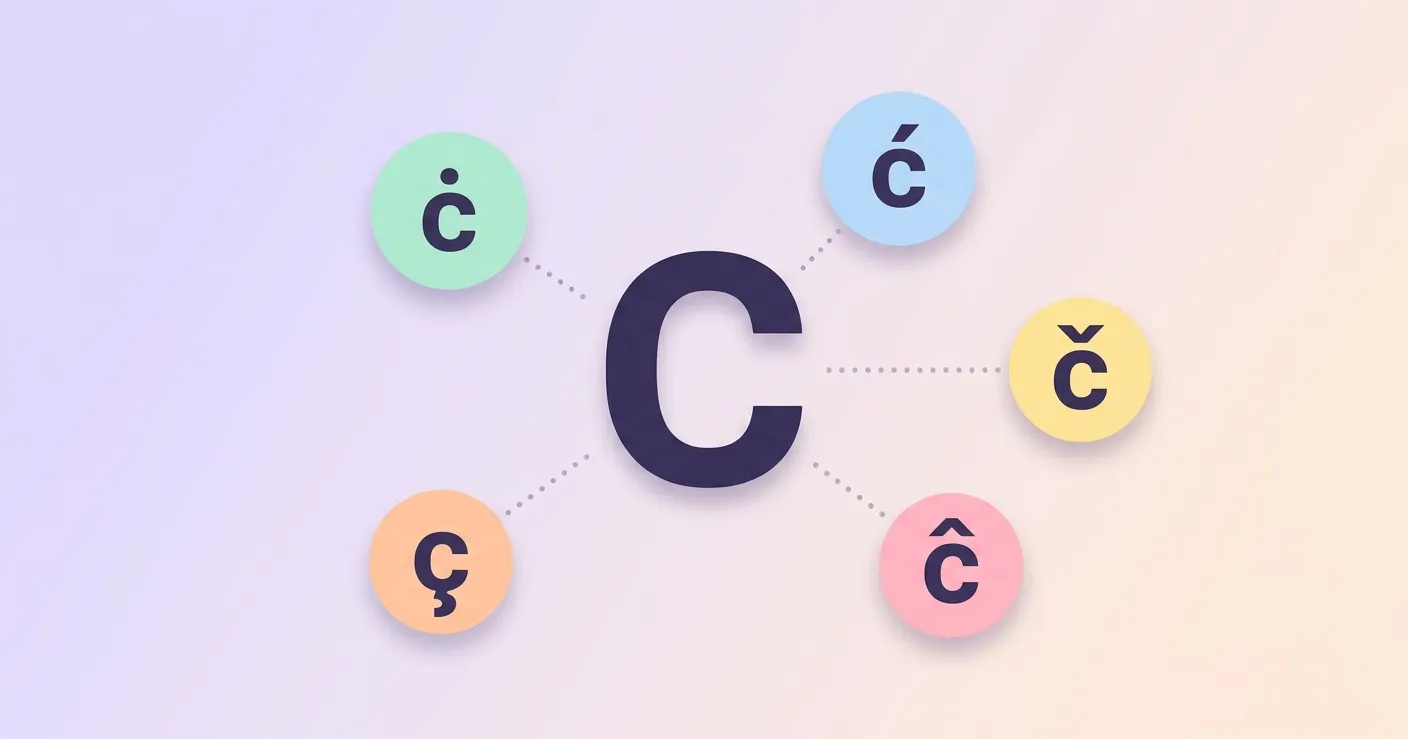

Below, you will find one click copy and paste for every lowercase and capital c with accent, a full alt code table, Mac keyboard shortcuts, Unicode references for developers, and a breakdown of how each accent is used across different languages. If you are looking for other letters with accents, check out the full guide on all accent letters.
C with accent Copy Paste
Every c with accent character below is ready to copy in one click. Just tap or click a symbol, and it is instantly copied to your clipboard, ready to paste into a document, chat, or website with no special keyboard or software needed.
Lowercase c with accent
Capital C with accent
Alt Code for c with accent
Alt codes let you type special characters on Windows using the numeric keypad. Whether you need c with caron, c with cedilla, c with acute, c with dot, or c with circumflex, each character below has its own unique code that inserts the exact symbol anywhere you type.
Follow these steps to type any c with accent symbol using its alt code.
- Turn on Num Lock on your keyboard's numeric keypad.
- Place your cursor where you want the character to appear.
- Press and hold the Alt key.
- Type the full alt code number using the numeric keypad, including any leading zero shown in the table.
- Release the Alt key, and the accented c will appear.
| Symbol/Mark | Alt Code |
|---|---|
| ć | ALT 263 |
| ċ | ALT 267 |
| ĉ | ALT 265 |
| č | ALT 269 |
| ç | ALT 135 |
| ȼ | ALT 572 |
| ḉ | ALT 7689 |
| ƈ | ALT 392 |
| Ć | ALT 262 |
| Ċ | ALT 266 |
| Ĉ | ALT 264 |
| Č | ALT 268 |
| Ç | ALT 128 |
| Ȼ | ALT 571 |
| Ḉ | ALT 7688 |
| Ƈ | ALT 391 |
C with cedilla
C with cedilla, written ç in lowercase and Ç in capital, is a c with a small hook, called a cedilla, attached underneath. It softens the hard k sound of c into an s sound, and it is one of the most widely recognized accented letters in Western European writing.
French uses ç in words like garçon (boy) and français (French), always before a, o, or u where the c would otherwise sound hard. Portuguese uses it in cabeça (head) and moça (young woman), and Catalan uses it in plaça (square). Turkish and Azerbaijani also use ç, though there it represents a "ch" sound instead, as in çay (tea).
Interestingly, the cedilla was actually born in Old Spanish, where it marked a distinct sibilant sound. Spanish dropped the symbol during a spelling reform in the early 1800s and now uses z or c instead, which is why ç never appears in modern Spanish.
C with caron
C with caron, written č and Č, carries a small v-shaped mark called a caron or háček above the letter. It changes the sound of c to a "ch" as in "church," and it is a core letter in several Central and Eastern European alphabets.
Czech and Slovak both rely on č in everyday words such as čaj (tea) and měsíc (moon). Croatian, Bosnian, and Serbian, when written in Latin script, also use č, as in čovjek (person). Latvian and Lithuanian include it too, and it commonly appears in surnames and place names across the region.
C with acute
C with acute, written ć and Ć, has a single upward stroke above the letter known as an acute accent or kreska. It produces a soft, palatalized sound, similar to a gentle "ch," and is easy to confuse with c with caron since the two sounds are close but distinct.
Polish uses ć in words like być (to be) and gość (guest), where it sits alongside the country's other kreska letters. Serbian, Croatian, and Bosnian also use ć in Latin script, as in sreća (happiness or luck), where it contrasts directly with the harder č sound in the same alphabet.
C with a dot
C with a dot above, written ċ and Ċ, places a single small dot over the letter. It is a defining feature of the Maltese alphabet, where it represents a "ch" sound, and it rarely appears outside of Maltese or specialized linguistic transcription.
In Maltese, ċ shows up in common words such as ċikkulata (chocolate) and faċli (easy). Because Maltese blends Semitic and Romance roots, this dotted c helps distinguish it from the plain k sound written with a regular c, keeping pronunciation clear in everyday spelling.
C with circumflex
C with circumflex, written ĉ and Ĉ, wears a small upward hat above the letter. It is best known from Esperanto, the constructed international language, where it represents a "ch" sound and helps keep the alphabet fully phonetic with one letter per sound.
Esperanto speakers use ĉ constantly, in words like ĉu (whether, used to open yes or no questions) and ĉambro (room). Outside Esperanto, this letter is uncommon, though it occasionally appears in academic transliteration systems for languages that need a distinct "ch" symbol.
C with stroke
C with stroke, written ȼ and Ȼ, has a horizontal line drawn through the letter. It is not part of any major national alphabet. Instead, it shows up mainly in phonetic transcription, where it represents a "ts" sound, similar to the end of the English word "cats."
Linguists use ȼ in transcription systems for several Indigenous languages of Mexico, and the Saanich language of North America uses its capital form for a "kw" sound. Because it is rare, many fonts substitute the cent sign (¢) when ȼ is not available, so double check the character before publishing text that uses it.
C with hook
C with hook, written ƈ and Ƈ, has a small curved hook attached to the letter. It appears in a handful of African language orthographies, including Serer, spoken in Senegal, and it was once part of the official International Phonetic Alphabet before being retired in 1993.
When it was part of the IPA, lowercase ƈ represented a voiceless palatal implosive, a sound produced by drawing air inward while the tongue presses against the roof of the mouth. Today, you are most likely to encounter this letter in linguistic literature or in African language texts rather than in everyday writing.
C with accent in different languages
French c with accent
French uses exactly one accented c, the cedilla in ç. It only ever appears before a, o, or u, since c already sounds soft before e and i without any help. Common examples include garçon, français, leçon, and reçu, all frequent in everyday French vocabulary.
Spanish c with accent
Modern Spanish does not use any accented form of c. The cedilla actually originated in medieval Spain, but an 18th century spelling reform replaced ç with z or plain c, so words that once used it, like cabeça, are now spelled cabeza. Spanish speakers today rely on plain c and z instead.
Serbian c with accent
Serbian, when written in Latin script, uses two different accented c letters, ć and č, and treats them as entirely separate letters from plain c. The Cyrillic alphabet, Serbia's other official script, represents these same sounds with the distinct letters ћ and ч instead of accent marks.
Czech c with accent
Czech relies on č, formed with a caron, to represent the "ch" sound in words like čaj (tea) and klíč (key). Unlike Polish or Serbian, Czech does not use c with acute, keeping its accented c system limited to this single, consistently used letter.
Other Slavic languages
Beyond Czech and Serbian, Slovak and Slovenian both use č, while Croatian and Bosnian use the same ć and č pair found in Serbian Latin script. Polish stands apart with ć instead of č for its softer sound. Russian, Ukrainian, and Bulgarian do not use accented Latin letters at all, since they are written in Cyrillic.
How to type c with accent on mac
On a Mac, ç is built directly into the keyboard, but the rest of the c with accent family needs a quick, one time setup called the ABC Extended keyboard layout. Follow the steps below, then use the table to find the exact combination for each character.
- Open System Settings, then go to Keyboard.
- Click Input Sources, or Text Input on newer versions of macOS, then click Edit or the plus button.
- Search for ABC Extended under the English keyboards, and add it to your list of input sources.
- Click the input menu flag icon in the menu bar, and switch to ABC Extended whenever you need to type these characters.
- Use the key combination from the table below, releasing the first two keys before pressing the final letter.
| Symbol/Mark | Mac Keyboard |
|---|---|
| ć | No direct shortcut, use Character Viewer (Control+Command+Space) or the Polish keyboard layout |
| ċ | Option+W, then C (ABC Extended keyboard) |
| ĉ | Option+6, then C (ABC Extended keyboard) |
| č | Option+V, then C (ABC Extended keyboard) |
| ç | Option+C |
| ȼ | No direct shortcut, use Character Viewer (Control+Command+Space) |
| ḉ | No direct shortcut, use Character Viewer (Control+Command+Space) |
| ƈ | No direct shortcut, use Character Viewer (Control+Command+Space) |
| Ć | No direct shortcut, use Character Viewer (Control+Command+Space) or the Polish keyboard layout |
| Ċ | Option+W, then Shift+C (ABC Extended keyboard) |
| Ĉ | Option+6, then Shift+C (ABC Extended keyboard) |
| Č | Option+V, then Shift+C (ABC Extended keyboard) |
| Ç | Shift+Option+C |
| Ȼ | No direct shortcut, use Character Viewer (Control+Command+Space) |
| Ḉ | No direct shortcut, use Character Viewer (Control+Command+Space) |
| Ƈ | No direct shortcut, use Character Viewer (Control+Command+Space) |
C accent unicode and different programming languages
The table below lists the Unicode code point for every c with accent variation, along with how to write it in HTML, CSS, and popular programming languages such as JavaScript, Java, and C.
| Name | Symbol/Mark | Unicode | HTML Hex | HTML Dec | CSS | JS,Java,C |
|---|---|---|---|---|---|---|
| Lowercase letter c with acute | ć | U+0107 | ć | ć | \0107 | \u{107} |
| Lowercase letter c with dot above | ċ | U+010B | ċ | ċ | \010B | \u{10B} |
| Lowercase letter c with circumflex | ĉ | U+0109 | ĉ | ĉ | \0109 | \u{109} |
| Lowercase letter c with caron | č | U+010D | č | č | \010D | \u{10D} |
| Lowercase letter c with cedilla | ç | U+00E7 | ç | ç | \00E7 | \u{E7} |
| Lowercase letter c with stroke | ȼ | U+023C | ȼ | ȼ | \023C | \u{23C} |
| Lowercase letter c with cedilla and acute | ḉ | U+1E09 | ḉ | ḉ | \1E09 | \u{1E09} |
| Lowercase letter c with hook | ƈ | U+0188 | ƈ | ƈ | \0188 | \u{188} |
| Capital letter C with acute | Ć | U+0106 | Ć | Ć | \0106 | \u{106} |
| Capital letter C with dot above | Ċ | U+010A | Ċ | Ċ | \010A | \u{10A} |
| Capital letter C with circumflex | Ĉ | U+0108 | Ĉ | Ĉ | \0108 | \u{108} |
| Capital letter C with caron | Č | U+010C | Č | Č | \010C | \u{10C} |
| Capital letter C with cedilla | Ç | U+00C7 | Ç | Ç | \00C7 | \u{C7} |
| Capital letter C with stroke | Ȼ | U+023B | Ȼ | Ȼ | \023B | \u{23B} |
| Capital letter C with cedilla and acute | Ḉ | U+1E08 | Ḉ | Ḉ | \1E08 | \u{1E08} |
| Capital letter C with hook | Ƈ | U+0187 | Ƈ | Ƈ | \0187 | \u{187} |
Conclusion
C with accent covers a wide family of letters, from the familiar French ç to the specialized ȼ and ƈ used mostly in linguistics. Whether you need a quick copy and paste, an alt code for Windows, a Mac shortcut, or a Unicode value for code, this guide gives you every method in one place, so you never have to search for these characters again.