
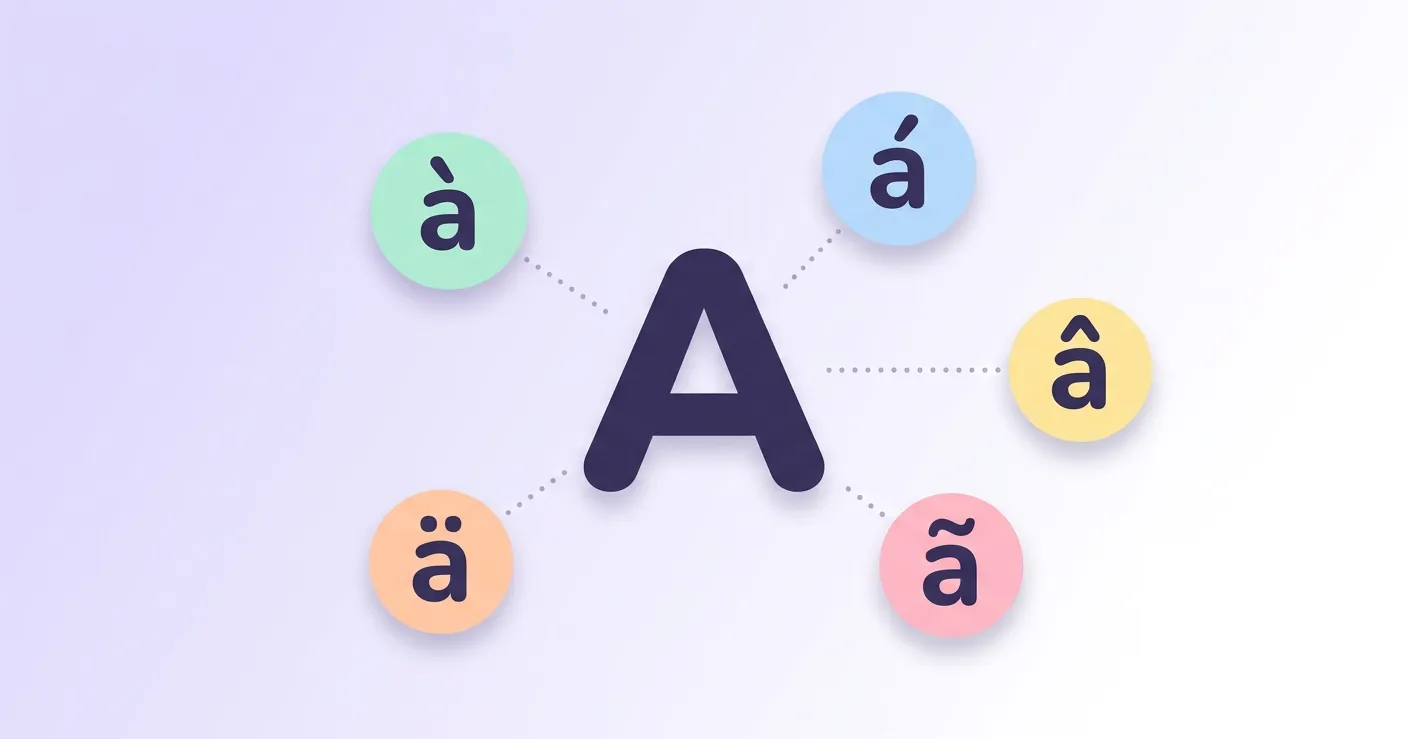

Stick around and you will find copy paste buttons for every variation, a full alt code reference table, dedicated sections for each accent mark with real language examples, Mac shortcuts, and a full Unicode table for developers working in HTML, CSS, JavaScript, Java, and C.
A with accent Copy Paste
Click any button below and the character copies straight to your clipboard, ready to paste into a document, message, or line of code. No need to memorize a single code.
If you're interested in learning more about other accents, this post about all accent letters alphabetically will give you a full overview.
Lowercase a with accent
Capital A with accent
Alt Code for a with accent
Alt codes let you type accented characters on Windows using the numeric keypad. Whether you need a with acute, a with grave, a with dot, a with macron, or a with tilde, every variation has its own four digit code that works across Word, Excel, and most text fields.
- Enable Num Lock on your keyboard, since alt codes only work through the numeric keypad.
- Place your cursor exactly where you want the accented letter to appear.
- Press and hold the Alt key.
- While still holding Alt, type the full numeric code shown in the table below on the numeric keypad, including any leading zero.
- Release the Alt key and the accented character appears automatically.
The table below lists the alt code for every variation covered in this guide, from the everyday accents to rarer combined marks like a with circumflex and acute, so you have one complete reference in a single place.
| Symbol/Mark | Alt Code |
|---|---|
| á | ALT 160 |
| à | ALT 133 |
| ȧ | ALT 551 |
| â | ALT 131 |
| ä | ALT 132 |
| ǎ | ALT 462 |
| ă | ALT 259 |
| ā | ALT 257 |
| ã | ALT 0227 |
| å | ALT 134 |
| ą | ALT 261 |
| ⱥ | ALT 11365 |
| ấ | ALT 7845 |
| ầ | ALT 7847 |
| ắ | ALT 7855 |
| ằ | ALT 7857 |
| ǡ | ALT 481 |
| ǻ | ALT 507 |
| ǟ | ALT 479 |
| ẫ | ALT 7851 |
| ẵ | ALT 7861 |
| ả | ALT 7843 |
| ȁ | ALT 513 |
| ȃ | ALT 515 |
| ẩ | ALT 7849 |
| ẳ | ALT 7859 |
| ạ | ALT 7841 |
| ḁ | ALT 7681 |
| ậ | ALT 7853 |
| ặ | ALT 7863 |
| æ | ALT 145 |
| ǽ | ALT 509 |
| ǣ | ALT 483 |
| Á | ALT 0193 |
| À | ALT 0192 |
| Ȧ | ALT 550 |
| Â | ALT 0194 |
| Ä | ALT 142 |
| Ǎ | ALT 461 |
| Ă | ALT 258 |
| Ā | ALT 0256 |
| Ã | ALT 0195 |
| Å | ALT 143 |
| Ą | ALT 260 |
| Ⱥ | ALT 570 |
| Ấ | ALT 7844 |
| Ầ | ALT 7846 |
| Ắ | ALT 7854 |
| Ằ | ALT 7856 |
| Ǡ | ALT 480 |
| Ǻ | ALT 506 |
| Ǟ | ALT 478 |
| Ẫ | ALT 7850 |
| Ẵ | ALT 7860 |
| Ả | ALT 7842 |
| Ȁ | ALT 512 |
| Ȃ | ALT 514 |
| Ẩ | ALT 7848 |
| Ẳ | ALT 7858 |
| Ạ | ALT 7840 |
| Ḁ | ALT 7680 |
| Ậ | ALT 7852 |
| Ặ | ALT 7862 |
| Æ | ALT 146 |
| Ǽ | ALT 508 |
| Ǣ | ALT 482 |
A with acute
A with acute is the letter a topped with a small upward stroke, written as á in lowercase and Á in capital. It usually marks a stressed syllable or a distinct vowel sound, and you will spot it across Spanish, Portuguese, Vietnamese, Icelandic, Czech, and several other languages.
In Spanish, the acute accent marks the stressed syllable and can shift a word's meaning entirely, as in está (is or stays) compared to esta (this). Portuguese uses á for an open, stressed vowel sound, seen in sofá (sofa), já (already), and há (there is).
Vietnamese pairs á with a rising tone, changing the word completely from other tone marks placed on the same base letter. Icelandic, Czech, Slovak, and Hungarian treat á differently again, using it to mark vowel length rather than stress. Icelandic á on its own means on or river, while Czech váza (vase) carries a long á against the short a in voda (water).
A with grave
A with grave carries a small downward stroke over the letter, written à in lowercase and À in capital. Unlike the acute accent, it rarely changes pronunciation on its own and instead helps separate words that would otherwise look identical, most notably in French and Italian.
French uses à mainly to tell homophones apart, since à (to, at) and a (the verb form of avoir) sound the same but mean different things, just as là (there) is separated from la (the). The accent barely affects pronunciation in French.
Italian relies on à to mark stress on a final vowel, changing how the whole word is read aloud, as in città (city) and già (already). Vietnamese uses à for a falling tone, and Catalan uses à for an open, stressed vowel, as in està (is or stays).
A with two dots (diaeresis)
A with two dots, known as a diaeresis or umlaut, is written ä in lowercase and Ä in capital. Unlike a stress mark, it usually signals a completely different vowel sound from plain a, most recognizable in German, Finnish, Swedish, and Estonian.
In German, ä represents a fronted vowel sound close to the e in bed, and it often appears in plural forms, as Mann becomes Männer. Words like Mädchen (girl) and Bär (bear) rely on this distinct sound rather than any added stress.
Finnish, Swedish, and Estonian treat ä as its own letter of the alphabet rather than an accented variant, placed near the end of their alphabets. Finnish äiti (mother) and Swedish äpple (apple) both use this separate vowel sound, not a modified a.
A with circumflex
A with circumflex is written â in lowercase and  in capital, marked by a small upward pointing hat above the letter. It most often signals a historical sound change or a lengthened vowel, and it plays a big role in French and Romanian spelling.
French circumflex usually marks a letter, often an s, that used to follow the vowel in Old French, as in château (castle) and âge (age). It also separates otherwise identical words, such as pâte (dough) from patte (paw).
Romanian uses â for the same central vowel sound as î, choosing â specifically inside a word, as in român (Romanian) and câine (dog). Vietnamese also treats â as a distinct short vowel, frequently combined with tone marks on top.
A with breve
A with breve is written ă in lowercase and Ă in capital, marked by a small upward curve that resembles a smile above the letter. It signals a short vowel sound, and it is a core letter in Romanian and Vietnamese rather than a rare accent mark.
In Romanian, ă represents its own central vowel sound, close to the a in about, and appears in everyday words like măr (apple) and casă (house). It counts as a distinct letter of the alphabet, not simply a variant of a.
Vietnamese uses ă for a short a sound that almost always carries a tone mark as well, as in ăn (to eat). In classical Latin pronunciation guides, the breve is used purely to mark that a vowel is short rather than long.
A with macron
A with macron is written ā in lowercase and Ā in capital, shown as a straight horizontal line above the letter. It marks a long vowel sound, and you will see it most often in Japanese romanization, Latvian, Lithuanian, and Polynesian languages like Māori and Hawaiian.
In Hepburn romanization of Japanese, ā shows that a vowel sound is held about twice as long as a plain a, as in obāsan (grandmother) and okāsan (mother). Getting the length right changes how natural the word sounds, even when the core meaning stays the same.
Māori and Hawaiian use the macron, called tohutō in Māori and kahakō in Hawaiian, to mark vowel length that can change a word's meaning entirely, as in Māori whānau (family). Latvian and Lithuanian also use ā for long vowels, seen in words like māja (house).
A with tilde
A with tilde is written ã in lowercase and à in capital, marked by a wavy line above the letter. It signals a nasal vowel sound, most recognizable in Portuguese, where it changes how a word sounds through the nose rather than the mouth alone.
Portuguese words like mãe (mother), irmã (sister), and the city name São Paulo all rely on ã for that nasal quality, and swapping it for a plain a changes the pronunciation noticeably. This works differently from the ñ used in Spanish, which marks a separate consonant sound instead of a nasal vowel.
Guarani and a handful of other languages also use ã to mark nasalization on vowels, following a pattern similar to Portuguese. Outside of these languages, ã rarely appears except in loanwords or transliterated names.
How to type accent a on mac
The steps and table below cover every core accent mark for the letter a on a Mac keyboard, using the built in Option key shortcuts that work in almost every app.
- Find the accent mark you need in the table below.
- Press the listed Option key combination first, then release both keys.
- Type the letter a for a lowercase result, or hold Shift and type A for a capital result.
- For macron or breve, press and hold the a key instead to open the accent popup, or switch to the Unicode Hex Input keyboard for direct codes.
| Symbol/Mark | Mac Keyboard |
|---|---|
| á | Option + E, then A |
| à | Option + `, then A |
| ä | Option + U, then A |
| â | Option + I, then A |
| ă | Character Viewer, search breve, or Unicode Hex Input + 0103 |
| ā | Press and hold A, then choose the macron option, or Unicode Hex Input + 0101 |
| ã | Option + N, then A |
| Á | Option + E, then Shift + A |
| À | Option + `, then Shift + A |
| Ä | Option + U, then Shift + A |
| Â | Option + I, then Shift + A |
| Ă | Character Viewer, search breve, or Unicode Hex Input + 0102 |
| Ā | Press and hold Shift + A, then choose the macron option, or Unicode Hex Input + 0100 |
| Ã | Option + N, then Shift + A |
A accent unicode and different programming languages
The table below contains the Unicode code point, HTML hex and decimal entities, CSS escape, and the shared escape format for JavaScript, Java, and C for every accent variation of a covered in this guide, useful whenever you need to insert these characters directly in your code.
| Name | Symbol/Mark | Unicode | HTML Hex | HTML Dec | CSS | JS,Java,C |
|---|---|---|---|---|---|---|
| Lowercase letter a with acute | á | U+00E1 | á | á | \00E1 | \u{E1} |
| Lowercase letter a with grave | à | U+00E0 | à | à | \00E0 | \u{E0} |
| Lowercase letter a with dot above | ȧ | U+0227 | ȧ | ȧ | \0227 | \u{227} |
| Lowercase letter a with circumflex | â | U+00E2 | â | â | \00E2 | \u{E2} |
| Lowercase letter a with diaeresis | ä | U+00E4 | ä | ä | \00E4 | \u{E4} |
| Lowercase letter a with caron | ǎ | U+01CE | ǎ | ǎ | \01CE | \u{1CE} |
| Lowercase letter a with breve | ă | U+0103 | ă | ă | \0103 | \u{103} |
| Lowercase letter a with macron | ā | U+0101 | ā | ā | \0101 | \u{101} |
| Lowercase letter a with tilde | ã | U+00E3 | ã | ã | \00E3 | \u{E3} |
| Lowercase letter a with ring above | å | U+00E5 | å | å | \00E5 | \u{E5} |
| Lowercase letter a with ogonek | ą | U+0105 | ą | ą | \0105 | \u{105} |
| Lowercase letter a with stroke | ⱥ | U+2C65 | ⱥ | ⱥ | \2C65 | \u{2C65} |
| Lowercase letter a with circumflex and acute | ấ | U+1EA5 | ấ | ấ | \1EA5 | \u{1EA5} |
| Lowercase letter a with circumflex and grave | ầ | U+1EA7 | ầ | ầ | \1EA7 | \u{1EA7} |
| Lowercase letter a with breve and acute | ắ | U+1EAF | ắ | ắ | \1EAF | \u{1EAF} |
| Lowercase letter a with breve and grave | ằ | U+1EB1 | ằ | ằ | \1EB1 | \u{1EB1} |
| Lowercase letter a with dot above and macron | ǡ | U+01E1 | ǡ | ǡ | \01E1 | \u{1E1} |
| Lowercase letter a with ring above and acute | ǻ | U+01FB | ǻ | ǻ | \01FB | \u{1FB} |
| Lowercase letter a with diaeresis and macron | ǟ | U+01DF | ǟ | ǟ | \01DF | \u{1DF} |
| Lowercase letter a with circumflex and tilde | ẫ | U+1EAB | ẫ | ẫ | \1EAB | \u{1EAB} |
| Lowercase letter a with breve and tilde | ẵ | U+1EB5 | ẵ | ẵ | \1EB5 | \u{1EB5} |
| Lowercase letter a with hook above | ả | U+1EA3 | ả | ả | \1EA3 | \u{1EA3} |
| Lowercase letter a with double grave | ȁ | U+0201 | ȁ | ȁ | \0201 | \u{201} |
| Lowercase letter a with inverted breve | ȃ | U+0203 | ȃ | ȃ | \0203 | \u{203} |
| Lowercase letter a with circumflex and hook above | ẩ | U+1EA9 | ẩ | ẩ | \1EA9 | \u{1EA9} |
| Lowercase letter a with breve and hook above | ẳ | U+1EB3 | ẳ | ẳ | \1EB3 | \u{1EB3} |
| Lowercase letter a with dot below | ạ | U+1EA1 | ạ | ạ | \1EA1 | \u{1EA1} |
| Lowercase letter a with ring below | ḁ | U+1E01 | ḁ | ḁ | \1E01 | \u{1E01} |
| Lowercase letter a with circumflex and dot below | ậ | U+1EAD | ậ | ậ | \1EAD | \u{1EAD} |
| Lowercase letter a with breve and dot below | ặ | U+1EB7 | ặ | ặ | \1EB7 | \u{1EB7} |
| Lowercase letter ae | æ | U+00E6 | æ | æ | \00E6 | \u{E6} |
| Lowercase letter ae with acute | ǽ | U+01FD | ǽ | ǽ | \01FD | \u{1FD} |
| Lowercase letter ae with macron | ǣ | U+01E3 | ǣ | ǣ | \01E3 | \u{1E3} |
| Capital letter A with acute | Á | U+00C1 | Á | Á | \00C1 | \u{C1} |
| Capital letter A with grave | À | U+00C0 | À | À | \00C0 | \u{C0} |
| Capital letter A with dot above | Ȧ | U+0226 | Ȧ | Ȧ | \0226 | \u{226} |
| Capital letter A with circumflex | Â | U+00C2 | Â | Â | \00C2 | \u{C2} |
| Capital letter A with diaeresis | Ä | U+00C4 | Ä | Ä | \00C4 | \u{C4} |
| Capital letter A with caron | Ǎ | U+01CD | Ǎ | Ǎ | \01CD | \u{1CD} |
| Capital letter A with breve | Ă | U+0102 | Ă | Ă | \0102 | \u{102} |
| Capital letter A with macron | Ā | U+0100 | Ā | Ā | \0100 | \u{100} |
| Capital letter A with tilde | Ã | U+00C3 | Ã | Ã | \00C3 | \u{C3} |
| Capital letter A with ring above | Å | U+00C5 | Å | Å | \00C5 | \u{C5} |
| Capital letter A with ogonek | Ą | U+0104 | Ą | Ą | \0104 | \u{104} |
| Capital letter A with stroke | Ⱥ | U+023A | Ⱥ | Ⱥ | \023A | \u{23A} |
| Capital letter A with circumflex and acute | Ấ | U+1EA4 | Ấ | Ấ | \1EA4 | \u{1EA4} |
| Capital letter A with circumflex and grave | Ầ | U+1EA6 | Ầ | Ầ | \1EA6 | \u{1EA6} |
| Capital letter A with breve and acute | Ắ | U+1EAE | Ắ | Ắ | \1EAE | \u{1EAE} |
| Capital letter A with breve and grave | Ằ | U+1EB0 | Ằ | Ằ | \1EB0 | \u{1EB0} |
| Capital letter A with dot above and macron | Ǡ | U+01E0 | Ǡ | Ǡ | \01E0 | \u{1E0} |
| Capital letter A with ring above and acute | Ǻ | U+01FA | Ǻ | Ǻ | \01FA | \u{1FA} |
| Capital letter A with diaeresis and macron | Ǟ | U+01DE | Ǟ | Ǟ | \01DE | \u{1DE} |
| Capital letter A with circumflex and tilde | Ẫ | U+1EAA | Ẫ | Ẫ | \1EAA | \u{1EAA} |
| Capital letter A with breve and tilde | Ẵ | U+1EB4 | Ẵ | Ẵ | \1EB4 | \u{1EB4} |
| Capital letter A with hook above | Ả | U+1EA2 | Ả | Ả | \1EA2 | \u{1EA2} |
| Capital letter A with double grave | Ȁ | U+0200 | Ȁ | Ȁ | \0200 | \u{200} |
| Capital letter A with inverted breve | Ȃ | U+0202 | Ȃ | Ȃ | \0202 | \u{202} |
| Capital letter A with circumflex and hook above | Ẩ | U+1EA8 | Ẩ | Ẩ | \1EA8 | \u{1EA8} |
| Capital letter A with breve and hook above | Ẳ | U+1EB2 | Ẳ | Ẳ | \1EB2 | \u{1EB2} |
| Capital letter A with dot below | Ạ | U+1EA0 | Ạ | Ạ | \1EA0 | \u{1EA0} |
| Capital letter A with ring below | Ḁ | U+1E00 | Ḁ | Ḁ | \1E00 | \u{1E00} |
| Capital letter A with circumflex and dot below | Ậ | U+1EAC | Ậ | Ậ | \1EAC | \u{1EAC} |
| Capital letter A with breve and dot below | Ặ | U+1EB6 | Ặ | Ặ | \1EB6 | \u{1EB6} |
| Capital letter AE | Æ | U+00C6 | Æ | Æ | \00C6 | \u{C6} |
| Capital letter AE with acute | Ǽ | U+01FC | Ǽ | Ǽ | \01FC | \u{1FC} |
| Capital letter AE with macron | Ǣ | U+01E2 | Ǣ | Ǣ | \01E2 | \u{1E2} |
Conclusion
Whether you needed a quick copy paste character, a Windows alt code, a Mac shortcut, or a Unicode reference for your code, this guide has you covered for every variation of a with accent. Bookmark this page any time you need á, à, â, ä, ā, ã, or ă again, along with their rarer combined forms.